The global demand for data storage is growing at a rate conventional technologies cannot sustain. By 2025, an estimated 181 zettabytes of data will be generated annually worldwide — and existing solutions such as NAND flash, hard disk drives, and magnetic tape are approaching their fundamental physical limits.
FastComet proposes a radically different paradigm: colloidal memory, in which colloidal nanoparticles (NPs) dispersed in liquid act as carriers of data. An array of nanocapillaries stores information as the specific stacking sequence of two distinct types of NPs — controlled by dielectrophoretic (DEP) forces from gate electrodes. The long-term target is a storage density exceeding 100 Gbit/mm² — surpassing current Flash memory — at a cost per bit competitive with archival tape storage.
The fundamental insight: dissociating the data storage medium from the read-write access device — as in hard disk drives — but taken to the nanoscale, with liquid as the medium and individual nanoparticles as the bits.
This is a first-of-its-kind concept and a genuine departure from all incumbent storage technologies. Unlike solid-state memories where cell size is limited by access device wiring, colloidal memory uses a volumetric liquid medium addressed by a dense nanocapillary array — a geometry that enables much higher information density in principle.
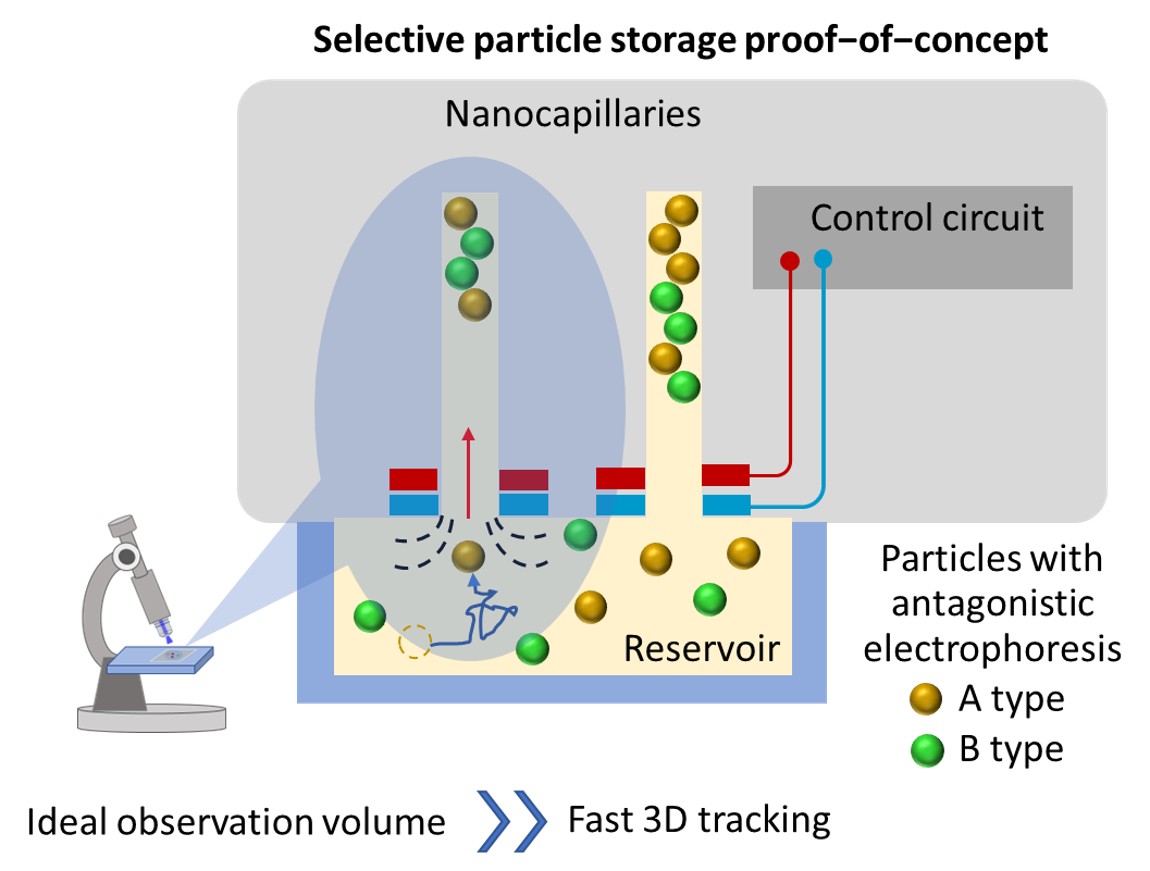
The operating principle relies on the antagonistic DEP response of two particle types: at a specific AC frequency, particle A is attracted into the capillary while particle B is repelled, and vice versa at a different frequency. By selecting the applied frequency, the circuit writes a specific sequence — equivalent to writing zeros and ones. Reading is performed optically, using the distinct fluorescent labels carried by each particle type.
My contribution to FastComet sits at the heart of the data writing validation work package (WP2). Demonstrating that the colloidal memory concept works requires imaging individual nanoparticles — particles as small as 15–50 nm — as they move in three dimensions within nanoscale capillaries, at frame rates exceeding 100 fps.
To meet this requirement, I am developing a custom multiplane widefield microscope (MWM) capable of simultaneous multi-colour 3D imaging across an 8-focal-plane stack, without sacrificing signal-to-noise ratio. The target is sub-10 nm spatial accuracy in 3D at >100 fps — roughly five times better than the current state of the art (20 nm, 20 fps).
Beyond imaging, I am developing single-particle tracking algorithms for recovering 3D motion traces of particles inside the DEP device, and an experimental methodology for measuring DEP forces on sub-100 nm particles — adapting approaches originally developed for optical trapping force calibration.
Nanoparticle Design & Synthesis
Designing organic and inorganic NPs (15–50 nm) with antagonistic DEP responses, optimised fluorescence, and surface chemistry. Led by UVigo & UNISTRA.
Data Writing Validation
Demonstrating selective, controllable trapping of NP sequences in nanocapillaries using multiplane microscopy and 3D single-particle tracking. Led by KU Leuven.
DEP Modelling
Computational modelling of NP electrokinetics and DEP forces in nanocapillary geometries to guide device and particle design. Led by UAM Madrid.
Prototype Nanofabrication
Fabricating nanocapillary test structures (≤80 nm diameter, ≥10:1 aspect ratio) with integrated DEP electrodes using IMEC's 300mm CMOS pilot line.
FastComet brings together five institutions spanning microscopy, nanoelectronics, colloidal chemistry, surface science, and computational modelling — a genuinely interdisciplinary team assembled around a single technological challenge.
The microscopy infrastructure developed for FastComet feeds directly into our other research lines. The multiplane widefield microscope — originally designed for this project — is also used for 3D optical matter tracking and multidimensional imaging of optoelectronic materials.
Single-particle tracking software developed for FastComet is available open-source on GitHub, alongside the 3D image analysis tools used across our group.
For the complete publication record from this research line, see my Google Scholar profile. The multiplane microscopy instrumentation also underpins publications on 3D particle tracking and nanoparticle dynamics in ACS Nano and related journals.