Optical matter (OM) refers to structures organised not by chemical bonds but by optical forces — the result of collective light-matter interactions between particles in a structured electromagnetic field. Like ordinary matter where electron exchange forms chemical bonds, optically bonded particles are organised by photon exchange interactions, making OM the photonic analogue of atomic or molecular matter.
This research line is supported by my FWO Junior Postdoctoral Fellowship at KU Leuven. It centres on a fundamental discovery: optical binding can occur outside the laser irradiation zone — nanoparticles organise themselves at distances far from the laser focus, driven by scattered fields rather than direct illumination. This challenges the conventional picture of optical trapping and opens new possibilities for non-invasive, large-area nanoparticle assembly.
Just as chemical bonds between different atoms create diverse molecular matter, optical bonds between different nanoparticles can create distinct types of optical matter — whose properties depend on the particles' geometry, composition, and the light field itself.
My role centres on custom microscopy development, 3D single-particle tracking, and quantitative data analysis — building the instruments and algorithms needed to observe phenomena that no commercial system can capture.
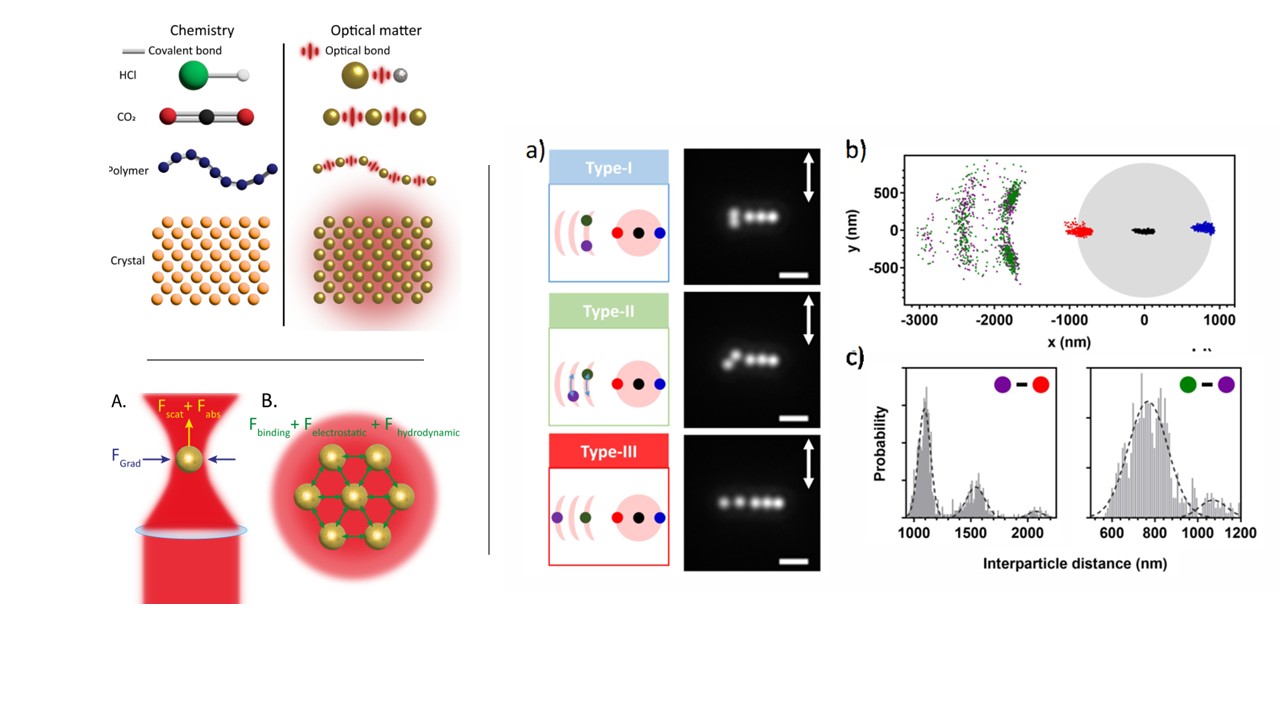
Historically, optical binding — the interparticle force arising from photon exchange — had only been reported within the irradiated area. The key discovery driving this phase was that gold nanoparticles can self-assemble into large, dynamic structures extending several micrometres beyond the laser focus, driven by light scattered outward from an antenna-like structure inside the irradiation zone.
The central result, published in Nature Communications (2022, co-first author with C.-H. Huang), showed that 400 nm Au NPs trapped at a glass/water interface form quantized arc-shaped distributions outside the focus, with interparticle distances at multiples of the half-wavelength — consistent with a backscattering mechanism. The external particles are not directly irradiated, yet display correlated motion characteristic of optical binding.
Building on this, the Junior Fellowship systematically explored how particle composition, size, shape, and scattering mode govern optical binding outside the irradiated area — using my custom-built multiplane widefield microscope (MPM) for 3D single-particle tracking at sub-15 nm spatial accuracy and >100 fps. Key findings include:
Laser & Optical Parameters
How wavelength, polarization, and beam profile (including Laguerre-Gaussian modes) govern the morphology and dynamics of optical binding networks outside the irradiated area.
Material Dependence
Systematic study across Au and Ag NPs of varying size, shape (spheres, rods), and surface chemistry — including hybrid metal-dielectric particles that exhibit unconventional OM behaviour.
Optical Binding Networks
3D SPT of fluorescently labelled tracers within dense optically binding networks, revealing hydrodynamic contributions and collective dynamics at high NP densities.
Theoretical Modelling
Development of quantitative models for outside-focus optical binding, incorporating backscattering, gradient forces, Van der Waals, hydrodynamic, and Marangoni forces.
This research line is deeply collaborative, spanning optics, theoretical physics, colloidal chemistry, and AI — with long-standing partners in Japan, Spain, and the United States.
Three PhD students are currently working within this research line under my co-supervision.
For the complete record, see my Google Scholar profile.