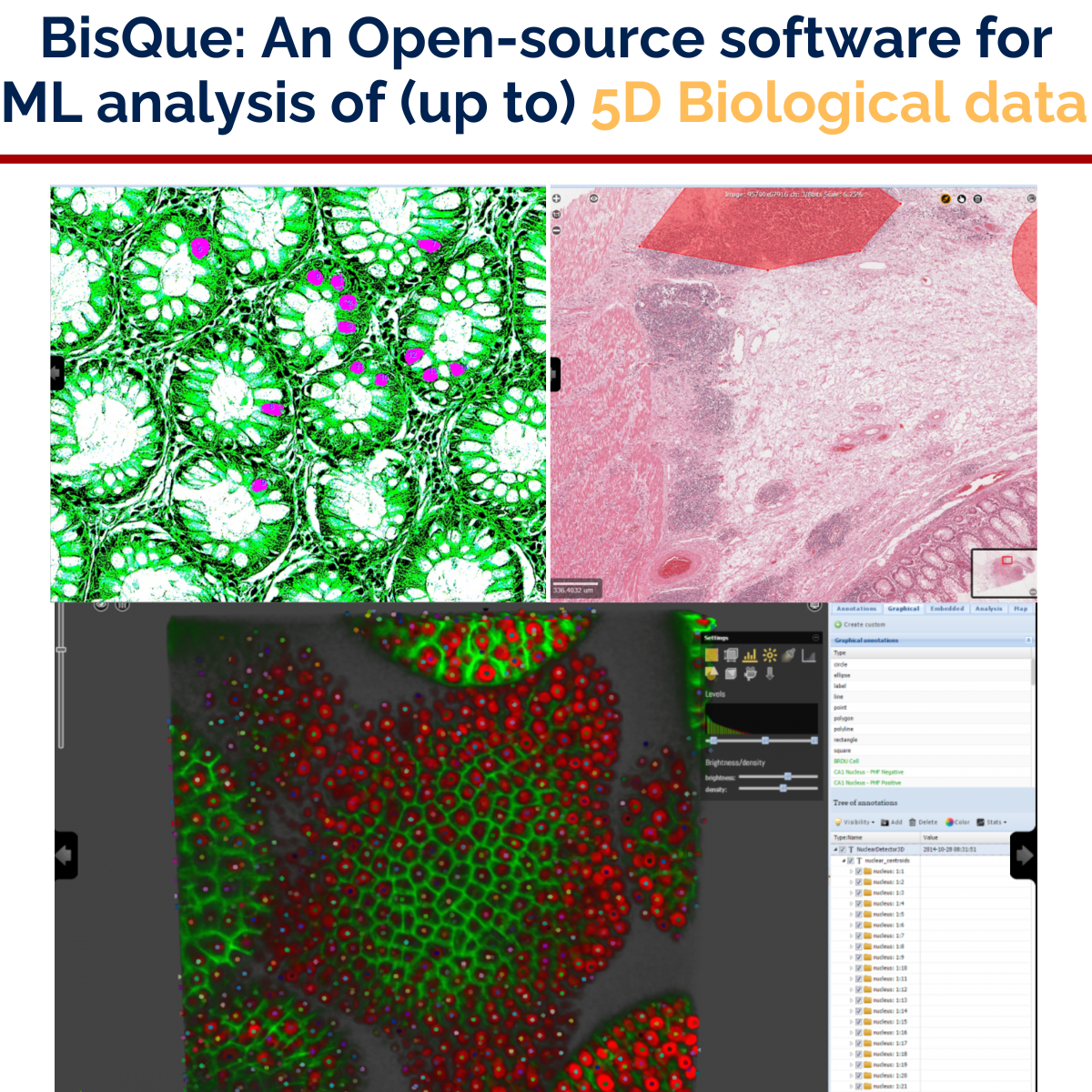
A free, open-access machine learning platform that handles up to 5D microscopy data, directly in your browser. No local installation required, no GPU cluster, no licence fees. It sounds almost too convenient to be true, but it exists, and it has been quietly powering research across multiple disciplines for years.
The Problem Most Labs Still Face
Most labs still analyse microscopy images manually, or rely on scattered scripts and local pipelines that were never designed to scale. A postdoc writes a MATLAB script, graduates, and the next person starts from scratch. Sound familiar?
Meanwhile, the datasets keep growing. 3D stacks, time-lapses, multichannel acquisitions. Files of 100 GB or more are no longer unusual. And with the rise of high-throughput microscopy and whole-slide imaging, the gap between data generation and data analysis widens every year.
The question then comes: is there a platform where you can store, annotate, and run machine learning on all of this, without installing anything locally?
Enter BisQue
It turns out there is. BisQue (Bio-Image Semantic Query User Environment) is an open-source, web-based platform developed at UC Santa Barbara's Vision Research Lab, funded by the National Science Foundation. It was specifically designed to give researchers organisational and quantitative analysis tools for up to 5D image data.
The key idea: you upload your data, annotate it, and run ML-based analysis modules, all from a web browser. No local installation, no dependency headaches.
I discovered BisQue at a Gordon Research Conference, where it was presented live. What struck me was not just the technical capability, but how accessible the whole thing is. Within minutes you can have it running locally via a single Docker command, or you can use the hosted web platform directly.
What Makes BisQue Stand Out
As someone who builds analysis pipelines in MATLAB and Python daily, a few features stood out immediately:
- 100+ biological image formats supported, including massive 5D datasets (x, y, z, time, channels).
- Built-in ML modules you can run directly on your data within the browser, covering segmentation, classification, and object detection.
- Extensibility: you can build and share your own analysis modules, written in Python, MATLAB, or Java+ImageJ.
- Cloud-scalable architecture that handles petabytes of images and millions of annotations, with flexible storage options including local, iRODS, or S3.
- Graphical and textual annotations with a rich set of tools (circles, ellipses, polygons, polylines, labels) directly in the viewer.
Who Uses It
BisQue is already actively used across a range of disciplines. In biomedical sciences, it supports work on disease mechanisms and medical imaging. In neuroscience, it helps analyse brain structures and neural networks. It is used in materials science for microstructure characterisation, in marine biology for ecosystem monitoring, and even in wildlife conservation for species tracking.
The platform's publications speak for themselves: from 3D grain shape generation in polycrystals, to automated segmentation for hydrocephalus analysis, to three-dimensional reconstruction of additively manufactured materials. The breadth is remarkable for a single platform.
Getting Started
The barrier to entry is extremely low. You have two options:
- Try the web platform at bisque2.ece.ucsb.edu — request an account and start uploading data.
- Run it locally with Docker: pull the image with
docker pull amilworks/bisque-module-dev:gitand run it withdocker run --name bisque --rm -p 8080:8080 amilworks/bisque-module-dev:git. Openlocalhost:8080and you are ready.
Alternatively, you can clone the GitHub repository and build the Docker image yourself.
Why This Matters for the Microscopy Community
Having a browser-based environment where you can not only view and annotate images but also deploy ML modules feels like a significant step toward making image analysis more reproducible and shareable across labs. The fact that it is open-source and NSF-funded, with no licence costs, makes it particularly relevant for academic groups that cannot afford commercial solutions.
As microscopy data volumes continue to grow and AI-driven analysis becomes standard practice, platforms like BisQue bridge the gap between generating data and extracting knowledge from it. And the more people know about it, the better the community modules and documentation will become.