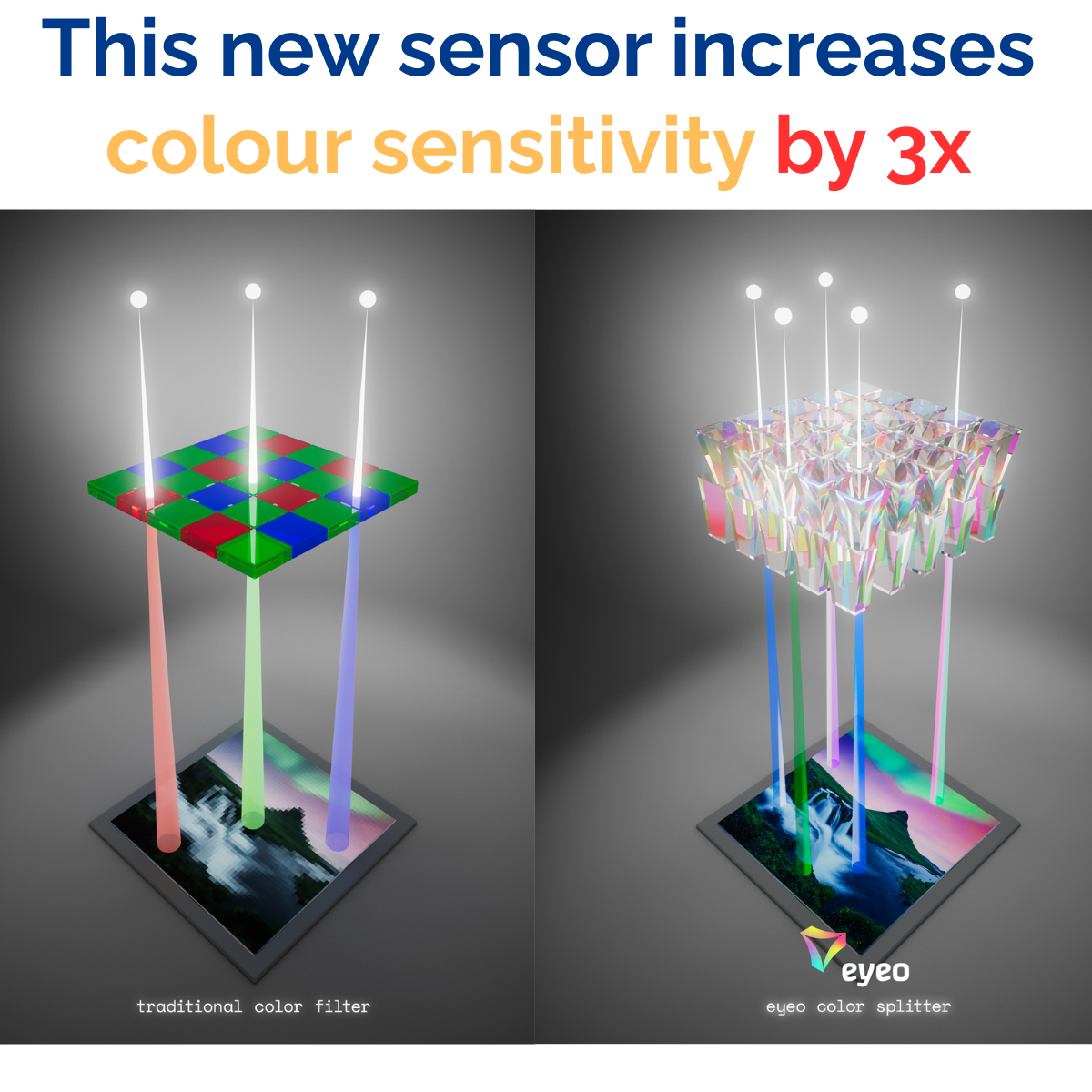
Every color camera sensor in the world — in your smartphone, in an endoscope, in a machine vision system — discards roughly 70% of the light that reaches it. It has done so since 1976. A Belgian-Dutch start-up backed by imec just raised €55 million to fix that, using a piece of nanophotonics that is genuinely elegant.
A fifty-year-old compromise
In 1976, Bryce Bayer at Kodak patented what would become the universal architecture for color photography: a mosaic of red, green, and blue absorptive filters placed directly over the pixel array of an image sensor — arranged in the now-iconic 2×2 pattern carrying twice as many green filters as red or blue. The Bayer Color Filter Array (CFA) was an elegant solution to a hard problem: how do you get color out of a sensor that is intrinsically color-blind?
The answer Bayer chose was to sacrifice photons. Each filter passes only the light matching its color and absorbs the rest. A red pixel filter absorbs green and blue photons. A green filter absorbs red and blue. The result: across any given exposure, roughly 70% of incoming photons are absorbed before they ever reach the sensor. The missing color information at each pixel is then reconstructed by interpolating from neighboring pixels — a process known as demosaicing.
For fifty years this was an acceptable trade-off. Sensors were large enough and pixels were big enough that there were plenty of photons to spare. But pixel sizes have been shrinking relentlessly — the current floor is around 0.5 µm — and at those dimensions, the lossy filter becomes a serious engineering bottleneck. Smaller pixels mean fewer photons per pixel, lower signal-to-noise ratio, and demosaicing artifacts that software can only partially hide. Manufacturers have compensated by making smartphone camera bumps larger. It works, but it is inelegant.
The question is not whether we can improve the filter. The question is whether we can eliminate it entirely — and still get color.
Routing photons instead of blocking them
Eyeo, a spin-off from imec (headquartered in Eindhoven, R&D in Leuven), proposes a fundamentally different architecture: instead of placing absorptive color filters on top of the pixels, replace them with an array of vertical nanophotonic waveguides that sort light by wavelength and direct each color to its designated pixel.
The structure — first presented at IEEE IEDM 2023 and now being commercialised under the name NCOS (Nanophotonic Color Splitting) — is built from Si₃N₄ multimode waveguides embedded in an SiO₂ matrix, fabricated using standard CMOS back-end-of-line processing on 300 mm wafers. No exotic materials. No new fabrication infrastructure.
The physics is worth dwelling on. Each waveguide has a tapered input aperture of roughly 800×800 nm — close to the diffraction limit — which couples nearly all incident photons into the structure. Inside the waveguide, the photons excite a combination of symmetric and antisymmetric propagation modes. Because these modes have different effective refractive indices, they travel at slightly different speeds and interfere with each other as they propagate. The resulting beat pattern is wavelength-dependent: red, green, and blue photons accumulate their respective phase shifts at different rates, and therefore exit the waveguide at spatially distinct positions on the pixel plane.
In other words, the color separation is a direct consequence of the waveguide geometry. It is deterministic, passive, and — critically — lossless in principle. No photons are absorbed. They are routed.
What this unlocks
- 3× light sensitivity compared to a Bayer sensor of equivalent size
- 2× effective spatial resolution — every pixel receives a full color value; no demosaicing interpolation required
- Sub-0.5 µm pixel pitch — the waveguide geometry allows pixel scaling beyond the conventional color diffraction limit
- >90% photon throughput across the 400–700 nm visible range (Vora color accuracy value >95%)
- Drop-in compatibility with existing CMOS image sensor platforms and high-NA camera optics
A note for the microscopy community
Most scientific microscopy cameras — sCMOS, EMCCD, scientific CCD — are grayscale by design. This is intentional: monochrome sensors offer superior quantum efficiency, lower read noise, and the flexibility to use any external spectral filter. Eyeo's technology is not targeting your detector. If you are doing single-molecule fluorescence, TIRF, or any photon-starved experiment, your grayscale sCMOS remains the right tool.
That said, color CMOS sensors matter enormously in a range of imaging contexts that are adjacent to — or embedded within — scientific practice. Digital pathology relies on color brightfield imaging of H&E-stained tissue. Surgical endoscopy requires color cameras in extremely constrained form factors. Intraoperative fluorescence guidance systems need compact, high-sensitivity color sensors. Automated cell culture monitoring platforms use color cameras for label-free classification.
Imec itself has already connected these dots: their hyperspectral imaging cameras, mounted on ZEISS surgical microscopes, have been tested for intraoperative detection of low-grade gliomas by feeding spectral data into deep-learning classifiers. The leap from Bayer replacement to wavelength-resolving nanophotonic sensors is not large — and it is worth watching.
Europe enters the image sensor stack
The image sensor market is dominated by three players: Sony, Samsung, and OmniVision. All three are based in Asia. European semiconductor research has produced world-class foundry knowledge (through imec, ASML, and others), but the image sensor stack itself has had very few European players at the leading edge.
Eyeo changes that calculus slightly. The company raised €15 million in seed funding in May 2025, and closed a €40 million Series A in May 2026 — investors include imec.xpand, Invest-NL, High-Tech Gründerfonds, and Innovation Industries. It is headquartered in the Eindhoven photonics cluster, which has coalesced around imec, PhotonDelta, and the High Tech Campus. First evaluation kits are expected to reach selected customers within two years.
Whether the Bayer filter — a fifty-year-old absorptive compromise — is finally on borrowed time depends on yield at scale, cost parity with incumbent technology, and how quickly OEM sensor manufacturers adopt the architecture. These are hard problems. But the physics is sound, the fabrication pathway is standard, and the performance claims are backed by peer-reviewed IEDM results. That combination is rare enough to be taken seriously.