Building a microscope from scratch is, paradoxically, one of the most information-rich and information-poor experiences in modern science. The tools exist. The designs are out there. The problem is that no one has drawn the map — until now.
If you have ever spent an afternoon crawling through GitHub, preprint servers, and lab websites trying to find whether a particular open-source microscope design already exists, you know the feeling. The open microscopy community is genuinely prolific. Groups around the world have released hardware blueprints, control software, analysis pipelines, and full datasets under open licences. The ecosystem is rich. But it is also scattered, and discovery is largely a matter of knowing the right person to ask.
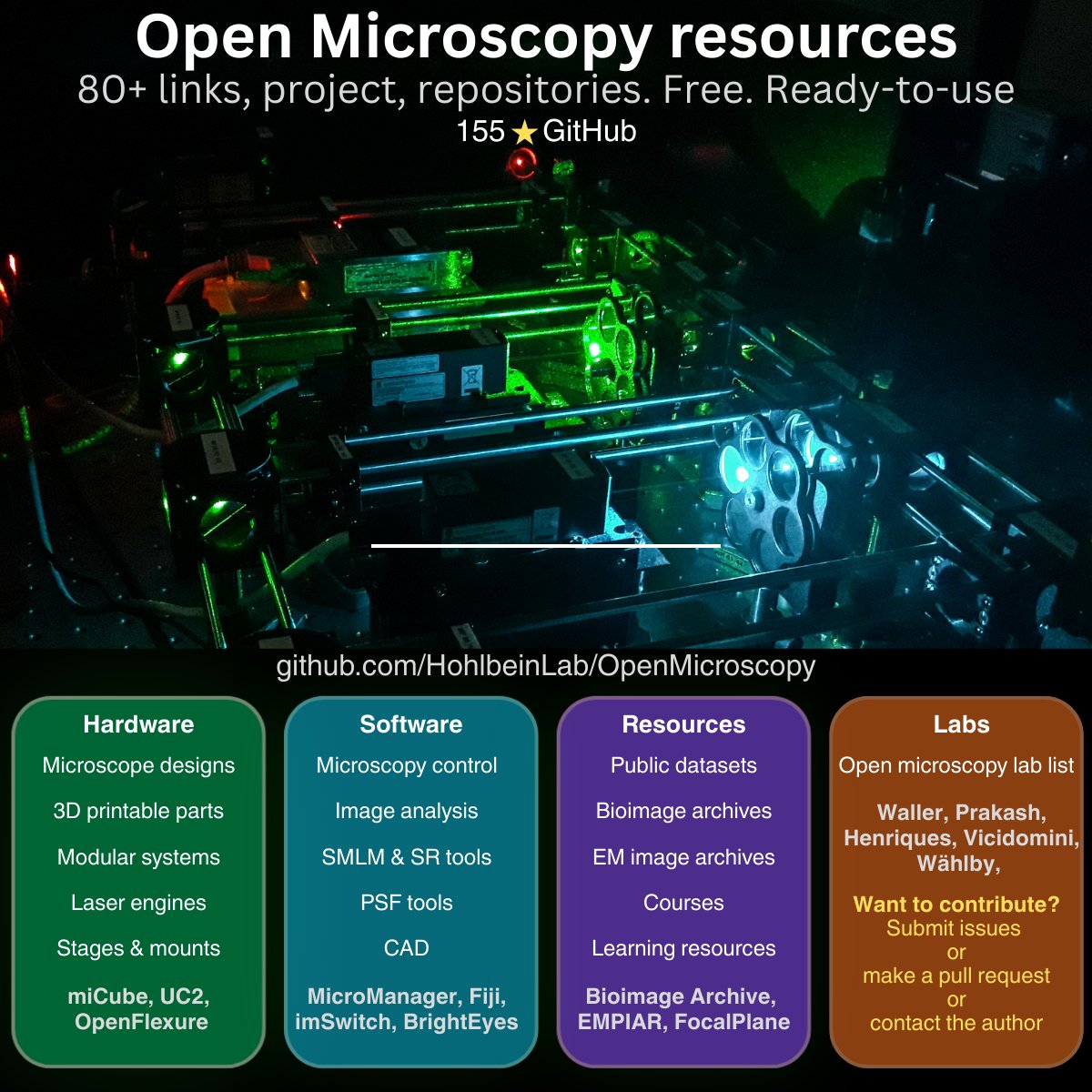
Johannes Hohlbein and the Hohlbein Lab at Wageningen University & Research decided to fix that. The result is OpenMicroscopy: a curated, community-maintained GitHub repository that indexes 80+ free, ready-to-use resources across hardware, software, data, and open labs.
"The problem isn't that open microscopy resources don't exist — it's that they're scattered everywhere." The OpenMicroscopy repository is the community's answer to that.
What the repository covers
The directory is organised into four broad categories. Rather than an exhaustive listing, here is what makes each section useful:
- Microscope designs & blueprints
- 3D-printable parts & modules
- Modular systems (miCube, OpenFlexure, Ries Lab)
- Laser engines & light sources
- Stages, mounts & mechanical components
- Microscope control: Micro-Manager, ImSwitch, BrightEyes
- Image analysis: ThunderSTORM, fairSIM, DL4MicEverywhere
- SMLM & super-resolution tools
- PSF characterisation & simulation
- CAD resources for custom optomechanics
- Public datasets for benchmarking
- BioImage Archive, EMPIAR, FocalPlane
- EM image archives
- Courses & learning materials
- Ricardo Henriques (UCL / IGC)
- Laura Waller (UC Berkeley)
- Manu Prakash (Stanford)
- Carolina Wählby (Uppsala)
- Giuseppe Vicidomini (IIT Genova)
- Jörg Enderlein (Göttingen) and many more
The labs section is particularly useful and often overlooked. It is one thing to find a piece of software; it is another to know which groups are actively releasing code and hardware, maintaining documentation, and welcoming external contributors. Having that list in one place changes how you approach a new project.
Why this matters for the field
Open instrumentation is not a niche concern. For groups working in low-resource environments, or for anyone trying to build something genuinely custom, commercial microscopes are often the wrong tool — too rigid, too expensive, or simply unavailable in the configuration you need. The open microscopy movement has spent the last decade demonstrating that research-grade performance is achievable with community hardware and software. What has been missing is the connective tissue: a reliable way to find what already exists before you start building from scratch.
The OpenMicroscopy repository addresses this at exactly the right level of abstraction. It does not try to be a software package or a hardware store. It is a map. Curation is deliberately human-maintained rather than algorithmically generated, which means the links are vetted and the categorisation reflects actual community usage rather than search engine optimisation.
With 155 GitHub stars and growing, it is quietly becoming the default starting point for anyone entering the open microscopy space — or for experienced researchers who want to audit whether a tool they built has already been released elsewhere.
How to contribute
The repository is explicitly community-driven. If you have a hardware design, a software tool, a dataset, or an open lab that should be listed, there are three ways to add it:
- Submit a GitHub issue — the lowest-friction option; describe the resource and the maintainers will review it.
- Make a pull request directly to the repository — preferred if you are comfortable with GitHub.
- Contact Johannes Hohlbein — useful if your resource is complex or does not fit neatly into existing categories.
The repository lives at github.com/HohlbeinLab/OpenMicroscopy. I am grateful to Johannes and his group for building this, for maintaining it openly, and for letting me share it here. A resource like this only gets more useful the more people know about it — and contribute to it.