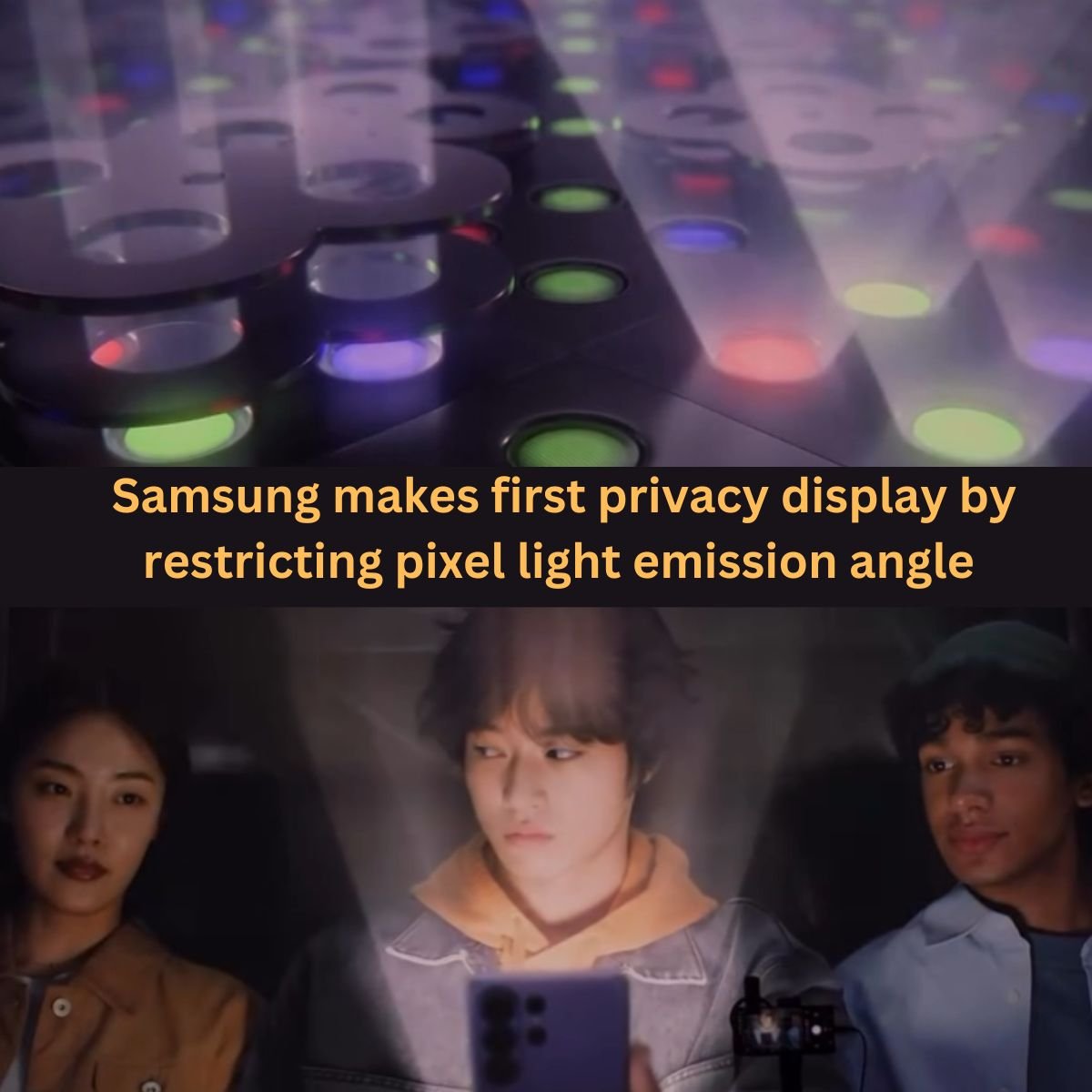
Privacy on a phone screen has always been a compromise — a plastic film that darkens everything, or nothing at all. Samsung's announcement for the Galaxy S26 Ultra changes the framing entirely: rather than adding a filter in front of the display, they have redesigned the pixel itself.
The approach is elegant in the way the best engineering solutions usually are — it solves the problem at the level where the problem actually originates. Light that you never emit sideways in the first place cannot be seen by someone standing beside you. The question then becomes purely one of optical engineering: how do you control the angular distribution of light emitted from a structure that is only a few micrometres across?
The Existing Problem with Anti-Spy Films
Anti-spy screen protectors have been a functional if imperfect solution for years. They work through a microlouver or polarization mechanism that absorbs or blocks light travelling beyond a narrow viewing cone. The trade-off is immediate: because polarization inherently eliminates approximately half of all emitted light, these films make the display significantly dimmer even when you are looking straight at it. They also create an all-or-nothing situation — the privacy mode cannot be toggled per application, and you cannot quickly open the screen to show something to a colleague without peeling off the film or disabling the effect.
Samsung's system eliminates both of these limitations by moving the angular control one level deeper — into the pixel architecture itself.
The Black Matrix: From Divider to Optical Structure
To understand the innovation, it helps to know what a Black Matrix is. Every OLED display contains an opaque layer — typically made from black resin or carbon-based material — that separates the red, green, and blue subpixels from each other. Its conventional role is to prevent colour from one subpixel bleeding optically into its neighbours, and to absorb ambient light that might otherwise reduce contrast by reflecting off the panel surface. In a standard OLED, this matrix is a single, relatively thin layer.
Samsung realised that by making this structure taller and multi-layered, they could turn a passive optical separator into an active angular aperture.
The principle is analogous to looking through a deep tube versus a shallow one. A short tube lets you see light arriving from a wide range of angles; a tall narrow tube restricts your view to nearly straight ahead. Samsung's multi-layer Black Matrix stacks several absorbing walls around each subpixel, creating exactly this tube-like geometry at micrometer precision. Light that tries to propagate sideways from the emitting layer simply encounters an absorbing wall before it can escape. The result is a dramatically narrowed emission cone — the subpixel still emits the same total number of photons, but they are confined to a tighter angular range around the display normal.
Two Types of Pixels Working Together
The second innovation is the mixed-pixel architecture. Samsung's panel contains two populations of pixels interleaved across the display: narrow pixels with the deep multi-layer Black Matrix structure (tight forward emission cone), and wide pixels with a conventional shallow Black Matrix (broad emission angle, standard OLED viewing experience).
This pairing gives the display a software-controlled privacy toggle with genuinely useful granularity. When privacy is off, both pixel types contribute to the image simultaneously — the wide pixels ensure broad, comfortable viewing angles and full perceived brightness, while the narrow pixels fill in their portion of the image with high-efficiency forward emission. The combined result is indistinguishable from a standard high-quality OLED display.
When privacy mode is activated, the wide pixels are suppressed entirely. Only the narrow pixels remain active. Because their emission is confined to a tight cone pointing directly at the viewer, the screen content is visible straight-on but essentially invisible at oblique angles. The numbers Samsung reports are striking.
brightness at 45°
brightness at 45°
brightness at 60°
A bystander glancing at your screen from the side sees roughly one hundredth of what you see head-on. That is not a marginal improvement — it effectively makes the screen opaque to anyone not in your direct line of sight.
Recovering Brightness: The LEAD 2.0 Connection
There is an unavoidable consequence to any angular-confinement strategy: if you restrict the emission cone of a subpixel, you are directing light into a narrower range of angles — but you are not making the subpixel dimmer in total. However, the perceived on-axis brightness depends on how efficiently the emitted light reaches the viewer, and a narrow cone means more of that light is usefully directed forward. This partially compensates for using only the narrow-pixel population in privacy mode.
Samsung pairs this architecture with their LEAD 2.0 platform, which removes the circular polarizer that standard OLED panels use to suppress ambient light reflections. A conventional OLED polarizer absorbs around 50% of the panel's emitted light as part of its anti-reflection function. By eliminating it — and managing reflection suppression through other means — Samsung recovers a significant brightness budget that offsets the directional loss inherent in privacy mode. The engineering balance is deliberate: the brightness lost to angular restriction is substantially recovered by removing the polarizer, leaving the overall display efficiency competitive.
What Makes This a Genuine Shift
The most interesting aspect of this development from an optics perspective is the scale. Controlling the angular distribution of light from a structure that is a few micrometres wide — smaller than the wavelength of light is long — requires precision at a level that was not achievable in display manufacturing until very recently. The multi-layer Black Matrix geometry Samsung describes is essentially a microscale optical baffle array, fabricated at the pixel level across millions of subpixels simultaneously.
The fact that this is being deployed in a consumer smartphone rather than a specialised military or enterprise display is a sign of how far micro-fabrication tolerances in the panel industry have advanced. Techniques that required cleanroom research environments a decade ago are now embedded in mass production.
I find this development interesting not just as a product feature but as a demonstration of what becomes possible when optical design thinking is applied at the device architecture level rather than as an afterthought. Privacy here is not an accessory — it is an intrinsic property of the light-emitting structure, configurable in software, applicable per application, and achieved without sacrificing the display's primary function. That is a qualitatively different kind of solution, and the physics behind it is clean.