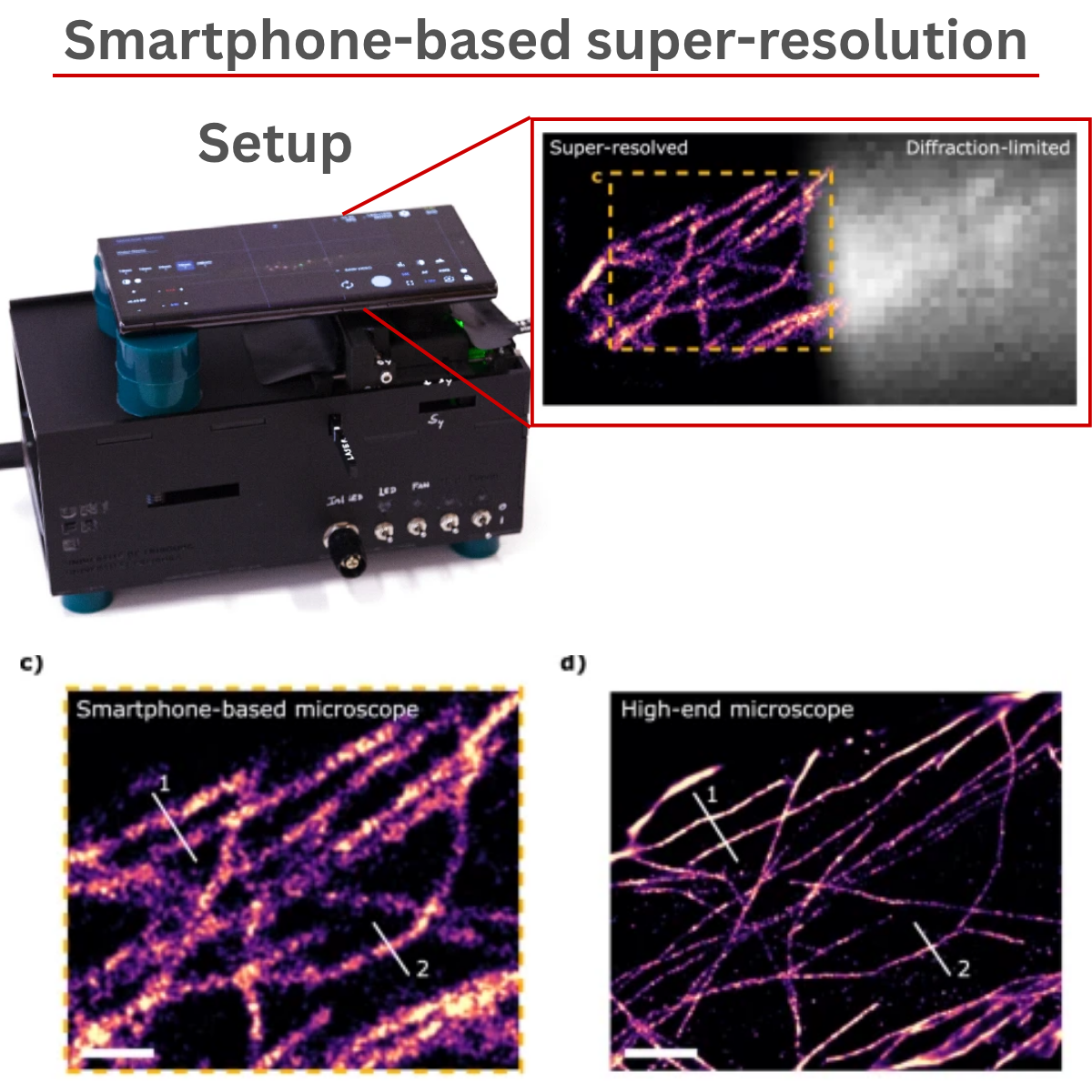
This week’s Paper Friday starts with a question that sounds like a stretch: could the phone in your pocket detect a single molecule and perform super-resolution imaging? It turns out the answer is yes — and the device that does it costs less than €350.
The price of seeing small
Microscopes are expensive instruments. Depending on capability they range from a few tens of thousands of euros to hundreds of thousands, and the most advanced systems reach into the millions. Sometimes that cost is genuinely necessary — the optics, detectors and stability required for high-end imaging do not come cheap. But the price tag also decides who gets to do the science. Labs in remote regions, institutions in developing countries, classrooms and field researchers are effectively locked out of techniques that elite facilities take for granted.
So the useful question is not whether expensive microscopes are worth it, but whether we can make a genuinely capable one cheap. Morgane Loretan and colleagues have answered it convincingly.
A portable microscope for under €350
Their device is portable, low-cost, and — this is the part that stops you — built for under €350. Despite that, it delivers true single-molecule sensitivity: it detects individual fluorescent dyes directly, not as an ensemble average but one molecule at a time.
That sensitivity is the hard part. Single-molecule detection normally implies carefully engineered excitation, efficient collection optics and a low-noise, cooled camera — exactly the components that drive cost up. Achieving it around a smartphone camera means the optical design is doing real work to concentrate signal and suppress background, rather than leaning on expensive hardware to brute-force the problem.
From detection to super-resolution
Detecting single molecules is impressive on its own, but the group goes further and performs super-resolution imaging using DNA-PAINT.
DNA-PAINT is a localization-based super-resolution method. Instead of relying on dyes that switch on and off spontaneously, it uses short dye-labelled DNA strands that transiently bind to complementary docking strands anchored on the target. Each binding event produces a brief flash; because the flashes are separated in time, an algorithm can localize each molecule with precision well below the diffraction limit. On this sub-€350 instrument, that precision reaches around 80 nm.
Not just a demo — a diagnostic
The result I find most telling is the application. The authors used the device for a point-of-care RNA bioassay, detecting an Ebola gene fragment. That moves the work out of the “clever proof of concept” category and toward something with real diagnostic reach.
What the device demonstrates
- Single-dye detection individual fluorophores registered directly
- DNA-PAINT super-resolution localization precision of roughly 80 nm
- Point-of-care RNA assay detection of an Ebola gene fragment
A point-of-care assay running on a smartphone-based reader is precisely the kind of tool that matters where centralised lab infrastructure is thin — in the field, in clinics without a molecular biology department, in settings where a million-euro microscope is not an option.
Why this direction matters
Beyond the optics, what this work really does is widen access. Turning a smartphone into a molecular sensor puts single-molecule sensitivity and super-resolution — capabilities that until recently belonged to well-funded facilities — within reach of labs, classrooms and field researchers who could never justify the cost of a conventional system.
I have a particular fondness for this kind of frugal instrumentation. It is a reminder that progress in microscopy is not only about pushing resolution or speed at the high end; it is also about collapsing the cost of what already works, so that more people can use it. Both directions expand the science. This one expands who gets to do it.
Congratulations to Morgane Loretan, Mariano Barella, Nathan Fuchs, Samet Kocabey, Karol Kołątaj, Fernando D. Stefani and Guillermo Acuna on a genuinely impressive contribution. The paper is published in Nature Communications and is available here.