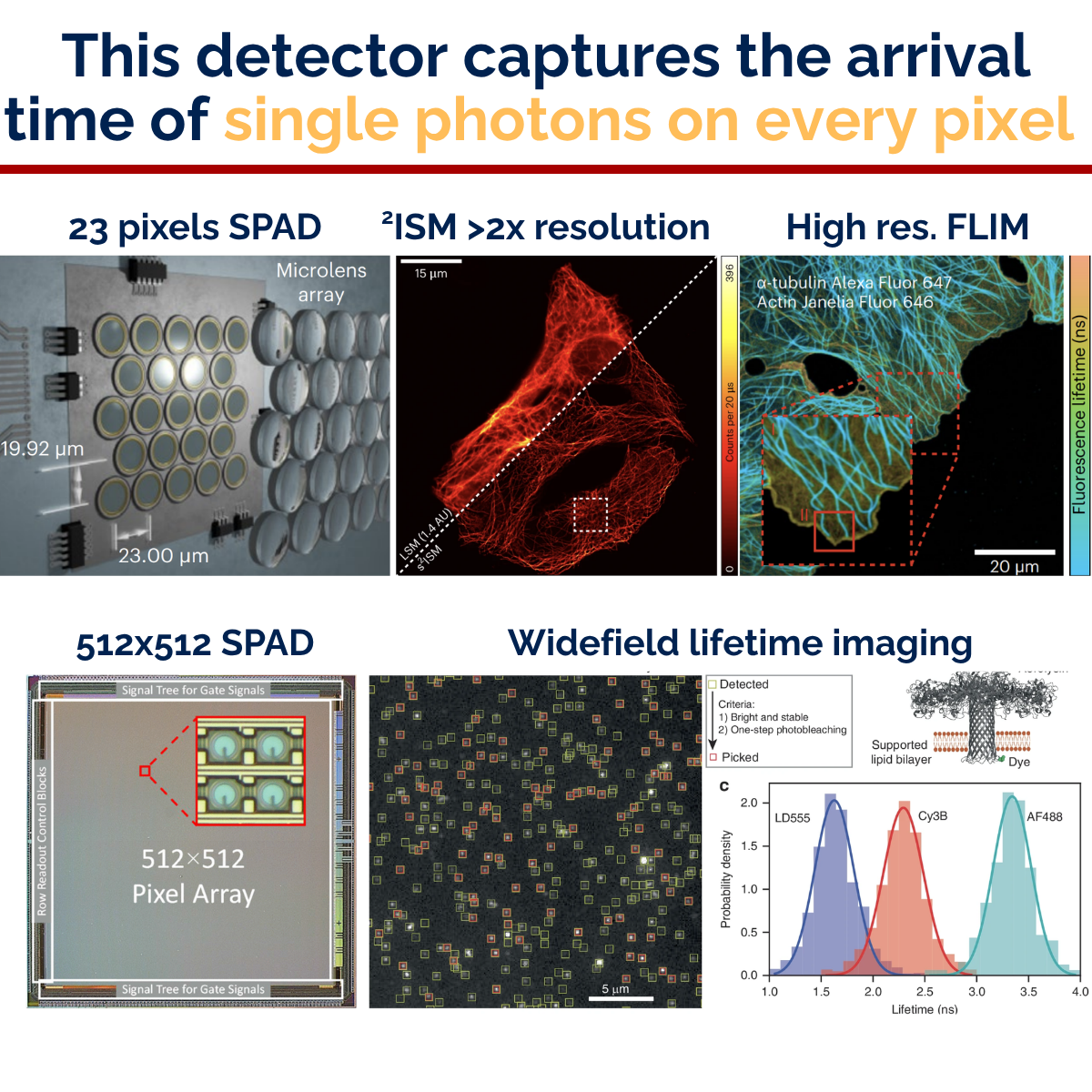
Every camera you have ever used works the same way: light lands on a pixel, and the pixel integrates however much of it arrives during an exposure. A single-photon detector does something different but incomplete on its own: it can tell you the exact moment a photon arrived, but usually only from one position at a time. Both approaches throw away information. Single-photon avalanche diode (SPAD) arrays are now showing up across microscopy labs precisely because they refuse to make that trade-off, and the consequences are starting to reach well beyond microscopy.
What a SPAD pixel actually does
A SPAD pixel is a diode biased above its breakdown voltage, so a single incoming photon is enough to trigger a self-sustaining avalanche of charge carriers. That avalanche produces a digital pulse, time-stamped with tens of picoseconds of precision, then the diode is quenched and reset for the next photon. Put many of these pixels side by side and you get an array where every position records not just whether light arrived, but exactly when. That combination, spatial resolution plus per-photon timing, is what a conventional camera or a single-point single-photon counter cannot offer on its own.
Arraying SPAD pixels has split into two rather different directions, depending on how many pixels you put together and what you do with them.
Small arrays: upgrading the confocal
Swap the point detector of a confocal microscope for a compact SPAD array, something like a 5×5 or 23-pixel grid, and each individual pixel behaves like a small virtual pinhole while the sum of all pixels reproduces the signal-to-noise ratio of a wide-open one. That is the basis of image scanning microscopy, and it has matured well beyond a proof of concept. A 2025 Nature Photonics paper from the Brighteyes project at IIT Genoa combined this structured detection with optical sectioning, pushing super-resolution imaging into thick biological tissue on a standard laser-scanning instrument. Groups working with Jörg Enderlein have taken a related route, pairing image scanning with fluorescence-lifetime single-molecule localization to roughly double the achievable resolution. The underlying detector concept traces back further still, to early work on using SPAD arrays for super-resolution localization microscopy and fast fluorophore blinking analysis.
What makes this approach attractive in practice is how little it disrupts an existing setup:
What a small SPAD array adds to a confocal
- Image scanning microscopy on an existing confocal, with no optical redesign required
- Resolution of a closed pinhole with the SNR of an open one, avoiding the usual trade-off
- FLIM, FCS, and fluctuation-based super-resolution on the same instrument, no separate detector needed
- Raw per-pixel data retained, so the reconstruction algorithm stays adaptive rather than fixed at acquisition time
Large arrays: widefield cameras
Scale the same pixel technology up to 512×512 or 1024×1024 elements and the character of the measurement changes entirely. These cameras now reach tens of thousands of frames per second, and when combined with time gating, opening a narrow window that is swept across the fluorescence decay, the whole field of view samples the decay in parallel instead of a single point being scanned across the sample.
The SwissSPAD2 sensor, a 512×512 gated SPAD array described in a widely cited 2018 IEEE paper, reaches close to 100,000 binary frames per second with sub-40 ps gate shifts. That combination of frame rate and timing precision is what makes video-rate, scan-free FLIM possible on a chip.
More recently, a gated single-photon camera built around this class of sensor was used to perform widefield fluorescence lifetime imaging of single molecules, a measurement that traditionally required point-scanning TCSPC and was intrinsically slow because of it. What I find most interesting in this generation of sensors is how independently you can now tune frame rate and gate position, treating them as separate variables rather than one fixed acquisition mode. That flexibility is what opens the door to new types of measurements rather than just faster versions of old ones.
What a large SPAD array enables
- FLIM without scanning, turning lifetime imaging into a genuinely widefield measurement
- Label-free metabolic imaging from NAD(P)H autofluorescence, acquired in seconds
- Photon correlation and quantum imaging, where knowing which pixels fired together matters as much as when
- Wide-field magnetometry with NV centres, extending the same timing precision beyond fluorescence
Beyond the microscope
The part of this story that goes past our field is that this device physics is no longer confined to research instruments. Canon has already commercialized this technology in consumer-facing products: the MS-500 interchangeable-lens camera pairs a 1-inch SPAD sensor with a resolution of 3.2 megapixels, aimed at ultra-low-light monitoring, with timing precision around 100 picoseconds. The same photon-counting principle that lets a SPAD array time-stamp a fluorescence photon in a lab also supports time-of-flight measurements, the basis for LIDAR and depth sensing in applications like autonomous vehicles. An earlier megapixel time-gated SPAD sensor Canon developed jointly with EPFL was explicitly built with both 2D imaging and 3D depth sensing in mind.
Where this leaves imaging
The direction of travel here seems clear: the same underlying pixel, a diode biased to fire on a single photon and stamp the time it arrived, is being deployed at wildly different scales, from a 23-pixel add-on that upgrades a confocal to a megapixel sensor sitting inside a commercial camera body. What ties them together is that none of them are throwing away information the way a conventional intensity camera does.
If your detector could time-stamp every photon that hit it, what would you measure first? If you want to go deeper on any of this, Giuseppe Vicidomini, Jörg Enderlein, Aleksandra Radenovic, and Edoardo Charbon are among the people actively pushing these detectors forward, and companies like Pi Imaging Technology (a ZEISS company) and Genoa Instruments are building instruments around them.